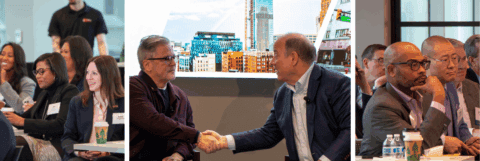
As Detroit Mayor Mike Duggan nears the end of his transformative 12-year tenure as Detroit’s Mayor, he sat down with Rocket Companies’ Dan Gilbert at the Detroit Regional Chamber to reflect on the city’s remarkable journey from crisis to progressing prosperity.
The Chamber has often recognized Duggan’s strategic and collaborative support of the business community and the significant role that he has played in the city’s growth and progress. Business leaders across various sectors shared remarks on their time collaborating with Duggan and the legacy he leaves behind in a room filled with business leaders and Chamber board members.
“When I talk with my peers, they tell me that the interest in their members about the growing excitement over what Mike Duggan has done in Detroit and what he can potentially do for the state just continues to grow,” said Sandy K. Baruah, President and Chief Executive Officer, Detroit Regional Chamber.
“Detroit knows exactly what it means to be an underdog, and we know what it means to stand back up in the face of adversity, keep believing, and win. That’s the same spirit that has defined Mike’s leadership over the past 12 years and has driven the amazing growth we’ve all seen and experienced over that time,” said Bob Riney, President and Chief Executive Officer, Henry Ford Health; First Vice Chair, Board of Directors, Detroit Regional Chamber.
“[Duggan] is a leader who solves problems, who watches every budget he’s responsible for ever so carefully — a leader who brings humility, discipline, and a heart to everything that he touches… When I look back over these 12 years, I’m reminded of what’s possible in America, especially with great leaders who believe in their communities, their citizens, and their country,” said Gary Torgow, Chairman, Board of Directors, Huntington National Bank.
“I had a lot of dreams about this country, and that’s only happened because of what was [happening] in Detroit. I worked hard and [hoped] the city would meet me halfway. Detroit did more than that – it helped open the door,” said Mamba Hamissi, Founder, Baobab Fare.
“We had a leader that cared enough to not only want manufacturing to come back to [Detroit], but he [Duggan] also rolled up his sleeves and created partnerships with me and other employers in town to make sure that we had what we need to put these business in the city,” said Sylvester Hester, President and Chief Executive Officer, LM Manufacturing, LLC.
“Mike did what a lot of cities take for granted. He focused on neighborhood and city services first. He really did turn thousands and thousands of streetlights back on, and he turned them on with technology… He restored what we now all take for granted, which are basic services: garbage pickup, snow removal, stronger emergency response, and blight removal,” said Cindy Pasky, President and Chief Executive Officer, Strategic Staffing Solutions; Past Chair, Board of Directors, Detroit Regional Chamber.
Turning Around a City in Crisis
Duggan’s leadership began at a time when Detroit was grappling with bankruptcy and a fractured culture. Opening the conversation, Gilbert asked Duggan to recount his first days in office as mayor, describing the daunting reality of taking back the operational reins from the city’s emergency financial manager. He faced a city where streetlights were out, abandoned houses and blighted lots overpowered neighborhoods, and ambulance response times were dangerously slow.
Duggan’s determination to restore basic services became his immediate mission, as he negotiated with state officials to regain control and set his sights on leading the city from retaining its residents to attracting them.
“We’ve had parents in the city telling their kids to go to school so you can move out of Detroit, and that’s changing now,” he said. “It’s been exciting to see more and more of our best talent from the city coming back home.”
The Value of Shared Vision
Duggan, who served on the Chamber’s Board of Directors when he served as Chief Executive Officer of the Detroit Medical Center, emphasized that Detroit’s most significant hurdle was not just economic but also cultural when he came into office, saying “I promised people that I would end when a ‘Black versus white, city versus suburbs, us versus them’ politics … we are going to need support from everybody.”
This message resonated within a city that hadn’t seen a white candidate in decades, highlighting the need for unity and support from all corners of the city to secure Detroit’s future. He noted that Detroiters understood the importance of moving beyond old divisions, and his administration worked closely with the City Council to foster a spirit of collaboration, especially on projects that would bring jobs to the city.
“You saw it when the [Detroit City] council and I disagreed with each other,” he said. “We never called each other out. We never attacked each other. Sometimes we disagreed on things, but you could feel the confidence of the public that they were watching leadership that they could be proud of in the way we conducted ourselves.”
The Housing Crisis in Detroit and Across the State
When asked what the key priority for Detroit mayor-elect Mary Sheffield should be, Duggan immediately answered with “housing.”
“As rents keep going up, if we do not keep building at a rapid rate, we’re going to start to face the pressures other cities have faced,” he said, noting that prioritizing affordable housing is key to staying ahead of the housing crisis.
The city’s current progress during Duggan’s tenure includes the restoration of thousands of vacant homes and the construction of affordable housing units. He has also proactively sought to address the challenge of high property taxes, advocating for a land value tax to incentivize development and penalize absentee landowners in Lansing.
A Ground-breaking Independent Candidacy for Governor
It was Duggan’s advocacy work for Detroiters that inspired his ground-breaking bid as an independent for Michigan’s governor, after getting politicians across the aisle to agree on reform, only to see it later crumble due to political posturing.
As he travels across the state to meet with voters, he shares his philosophy that lasting change requires collaboration and a focus on shared priorities rather than partisan interests – and is reaffirmed in his decision to run as an independent in Michigan’s gubernatorial race due to voters’ warm reception to his commitment to practical solutions and community engagement.
“I think there is a desire in this state to be able to talk about problems without losing their friends, to be able to go to the same events with your neighbors,” he said, and later added, “The two parties think they own the votes … You can win elections by effectively blaming the other side (but not providing solutions).”
The Chamber’s Political Action Committee endorsed Duggan historically early in July, about 18 months before the 2026 gubernatorial election, a decision that has since helped spur increased support statewide. The Chamber was also the first business organization to endorse Duggan in his first mayoral – support that continued in two subsequent re-elections as mayor.
A Legacy of Unity and Progress
As Duggan ends his tenure as Detroit Mayor, he leaves behind a legacy of the impact of inclusive, pragmatic leadership. His leadership offers a blueprint for cities facing similar challenges: focus on foundational issues, foster collaboration, and never lose sight of the community’s needs.